
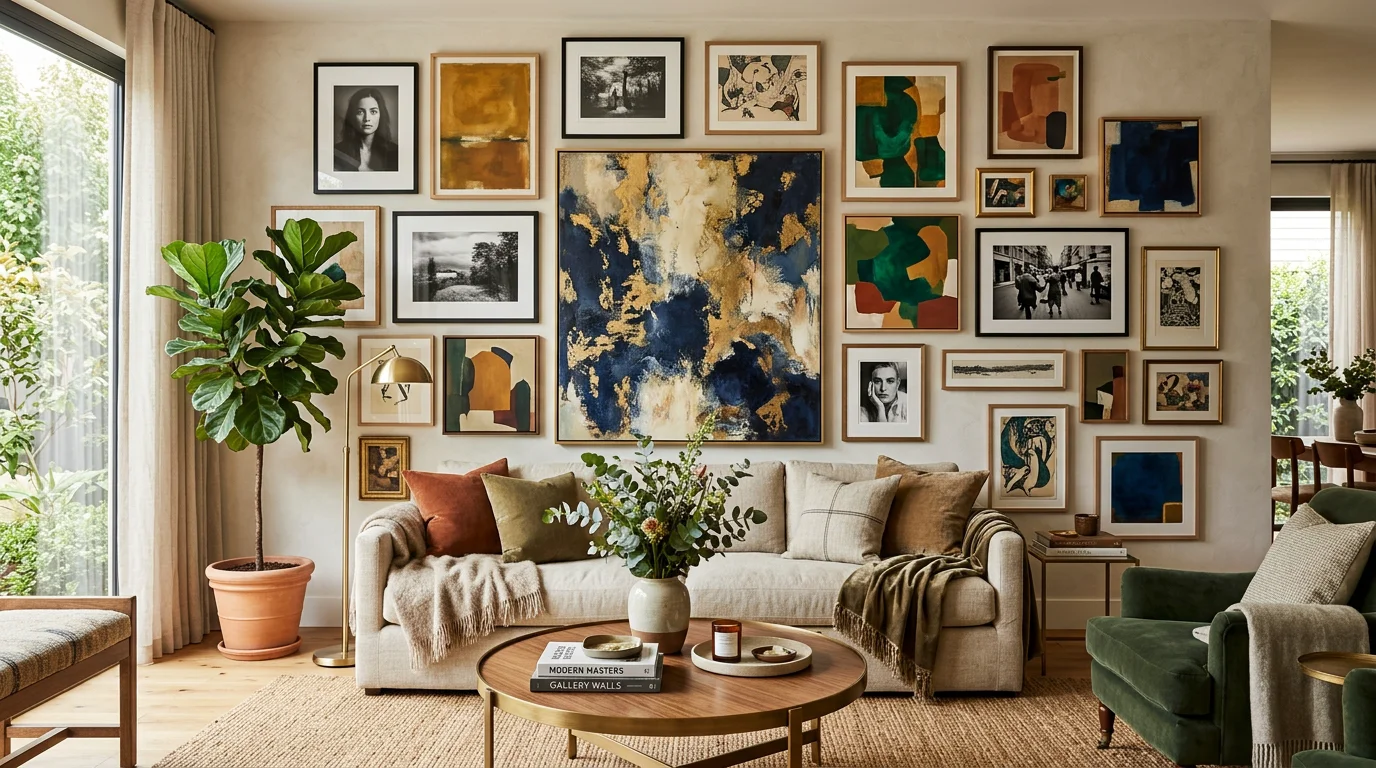

That big empty wall staring back at you holds more potential than you think. A thoughtful collection of framed pieces can become the heart of a room, and the best ideas for a wall art gallery begin with intention, not a hammer. If you want to go deeper on choosing and collecting art, our art gallery guide to exploring and buying is a practical place to start.
The appetite for filling walls is real and growing. The global wall art market was valued at $63.61 billion in 2024 and is projected to reach $118.79 billion by 2032, according to one industry analysis. That momentum is why so many people are rethinking their blank walls right now.
What actually makes a gallery wall work
A gallery wall is basically your own little art show, hung in your living room instead of a museum. Alone, each piece adds a bit of personality. Together, they tell a visual story. When people search for wall art gallery ideas, they're usually chasing that collected, lived-in feeling that a single poster can't deliver.
What separates a polished display from a cluttered one isn't the art itself. It's how the pieces play together: the mix of sizes, the varied frames, the spacing, the colors and textures. A little intention goes a long way toward cohesion and visual balance. Aim for a layout that feels deliberate, but never too perfect.
Plan the layout before you touch the wall
Before hanging anything, map out your vision. Clear a section of floor or a large table and arrange everything: frames, art, maybe a mirror or a round piece. Feeling ambitious? Trace each frame onto craft paper and tape those shapes up first. It's your no-pressure moment to test gallery wall layouts without a single hole.
A few reliable rules keep things anchored:
- Set the center at eye level. Aim for the middle of the arrangement around 57 inches from the floor, where art feels most natural.
- Keep 2 to 3 inches between pieces. Too much space feels scattered; too little reads as cluttered.
- Start with the largest pieces. Place them near the center to ground the display, then build outward with medium and small frames.
- Mix orientations. Combine vertical and horizontal pieces for movement, but keep the outer edges aligned for clean lines.
Don't shy away from a little asymmetry, either. An off-center anchor often feels more collected and relaxed than a rigid grid.
Gallery wall styles worth trying
There's no single right approach, so pick the mood that fits your room. A few crowd favorites:
- Minimal and modern: matching frames in matte black, white, or light oak, with simple prints and equal spacing.
- Eclectic and collected: mismatched frames, mixed materials, and a unifying thread like a shared palette or repeated brass and wood.
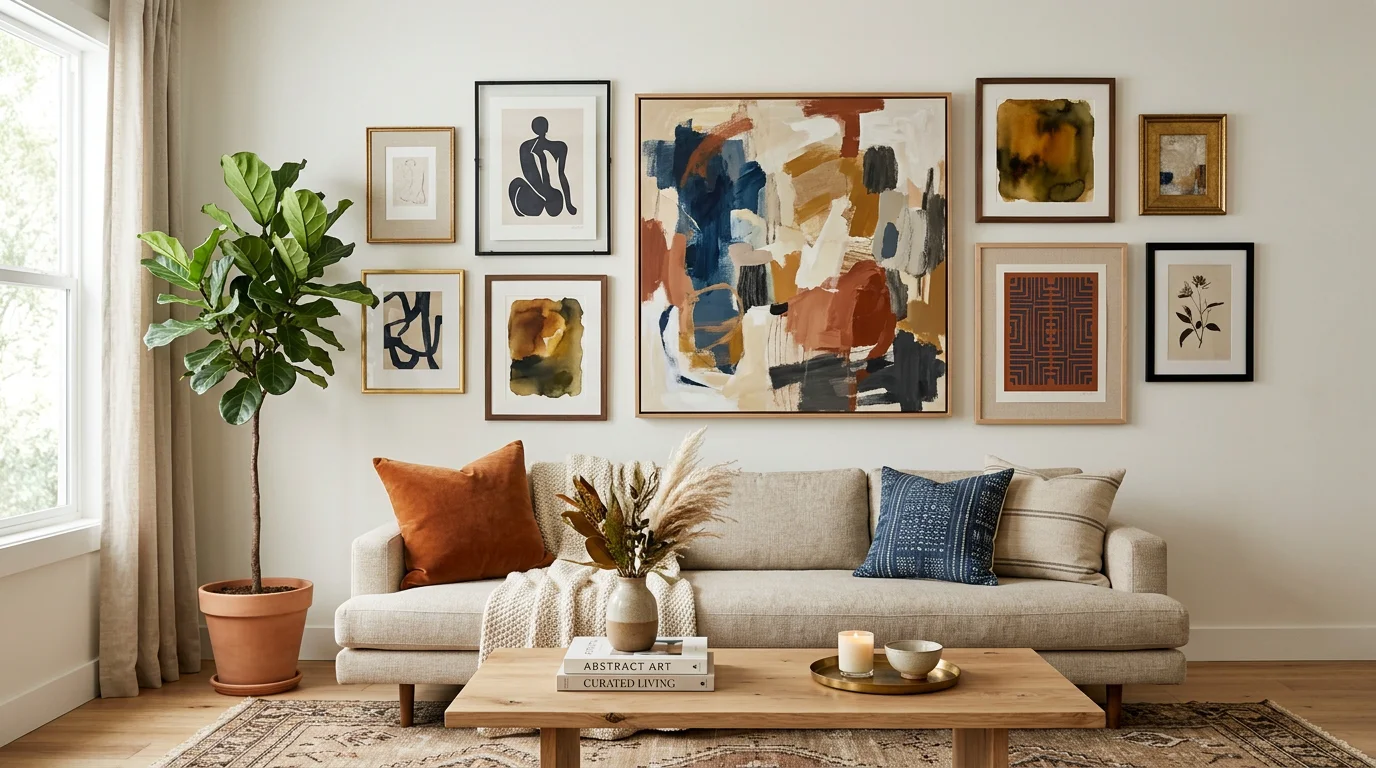
- Statement anchor with fillers: one large-scale piece sets the tone, and smaller minimalist prints echo its colors around it.
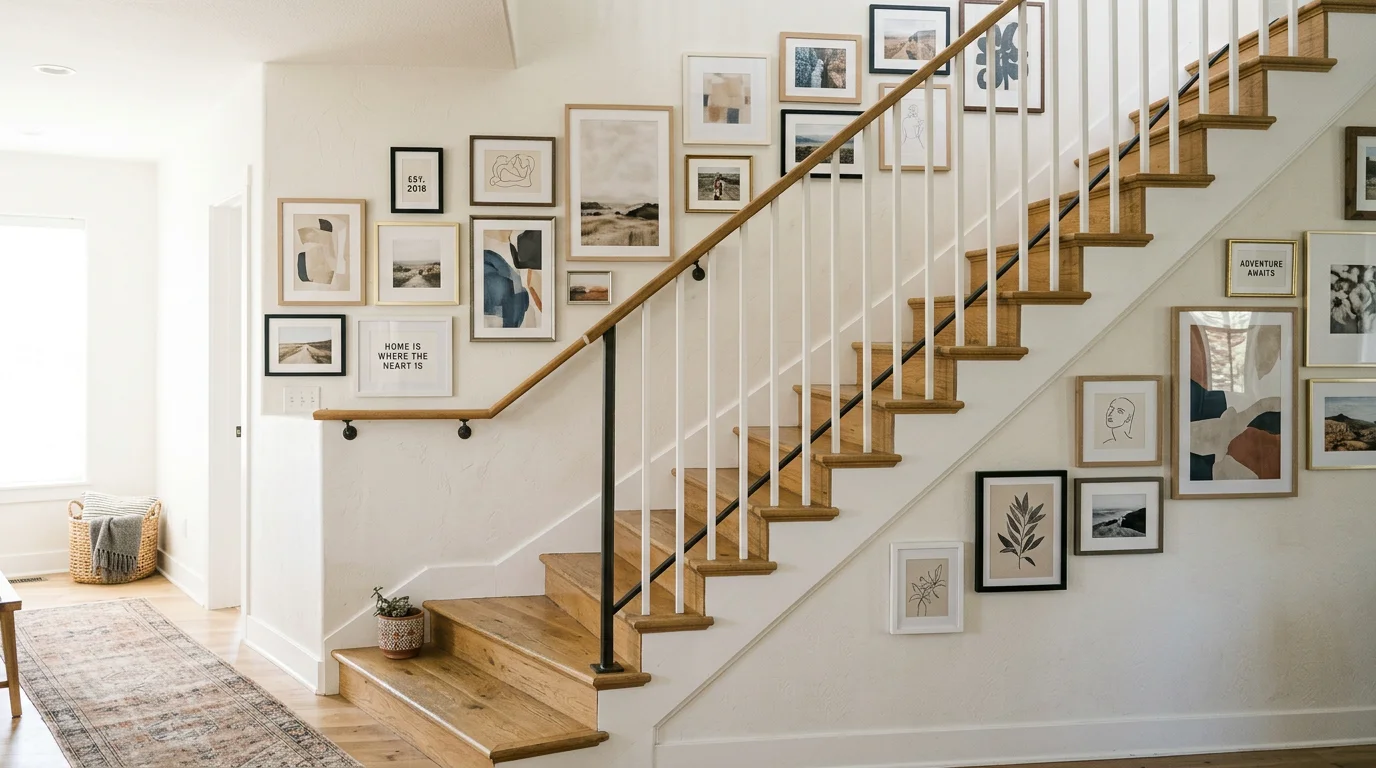
- Staircase story wall: a stepped arrangement that turns a pass-through space into something personal.
Diversity is what keeps the eye moving. Designers routinely recommend combining different genres, time periods, scales, and mediums to add depth. If you're hunting for a direction, you can see trending wall decor looks to spark your own mix before you commit.
The 2026 shift: fewer pieces, bigger impact
Here's the nuance most listicles skip: gallery walls are evolving, not disappearing. In 2026, they're becoming more curated and intentional, with fewer pieces carrying stronger visual presence rather than covering every inch of a wall. Some designers now favor a single oversized statement piece as an alternative to the crowded grid entirely.
Color is shifting too. Pinterest's 2026 trend report, which the platform credits with high accuracy, points to bold, color-forward maximalism replacing the muted minimalism of recent years, per a wall art data roundup. For your wall, that means high-contrast, high-saturation pieces tend to outperform flat, low-contrast tones that fade into the background. A two- or three-piece arrangement can absolutely hold its own.
The best gallery walls feel layered and collected over time, not assembled in an afternoon to match a catalog.
Original art versus prints: what to actually hang
The pieces you choose matter as much as the layout. Mass-produced prints are easy, but they rarely give a wall that one-of-a-kind pull. Original, hand-made work adds texture, brushwork, and a story you can't reproduce. If you're weighing your options, our explainer on how a contemporary art gallery works breaks down how buying directly from artists changes the experience.
Here's a quick comparison of common sourcing paths:
| Option | What you get | Made by hand | Personalization |
|---|---|---|---|
| Mass-market prints | Fast, low-cost, widely available | No | Minimal |
| Print-on-demand platforms | Large catalogs, digital designs | No | Limited |
| L'Original | Original signed works from 230 professional painters, from $680 CAD, with PickArt matching in about 2 minutes | Yes, every piece | High: buy, get a top-3 match, or commission a custom piece |
If you want a wall that feels genuinely yours, originals and commissioned pieces give you room to build a real collection instead of a catalog reprint.
Room-by-room placement ideas
Where you hang matters. The living room and dining room are classic candidates, but framed art increasingly fills trickier spots like staircases and corner nooks. Above-sofa and above-bed placements are the two most searched contexts for canvas prints, according to market data on canvas prints, which tells you buyers are solving specific room problems, not browsing at random.
A few starting points by space:
- Above the sofa: a statement anchor with a few smaller fillers, or a clean set of three.
- Dining room: a wall you face during meals, perfect for sparking conversation.
- Entryway or hallway: a narrow vertical arrangement that makes the space feel taller.
- Staircase: a stepped story wall that unfolds as you climb.
Whatever the room, add a little lighting once the art is up. A picture light or a pair of soft, warm sconces brings out texture and color without harsh glare on the glass.
Bringing it all together
A gallery wall rewards patience more than perfection. Choose a wall you see daily, settle on a vibe, lay everything out before you hang, and keep your spacing consistent with the center near eye level. The strongest gallery wall arrangements feel collected, not cluttered, and in 2026 that means leaning toward fewer, bolder, more personal pieces. Start with one anchor you love, then let the rest grow around it over time.
Take action with L'Original
Once your layout is planned, the piece at the center is what makes a wall unforgettable. That's where an original beats a reprint every time, giving your space texture, a signature, and a story worth hanging.
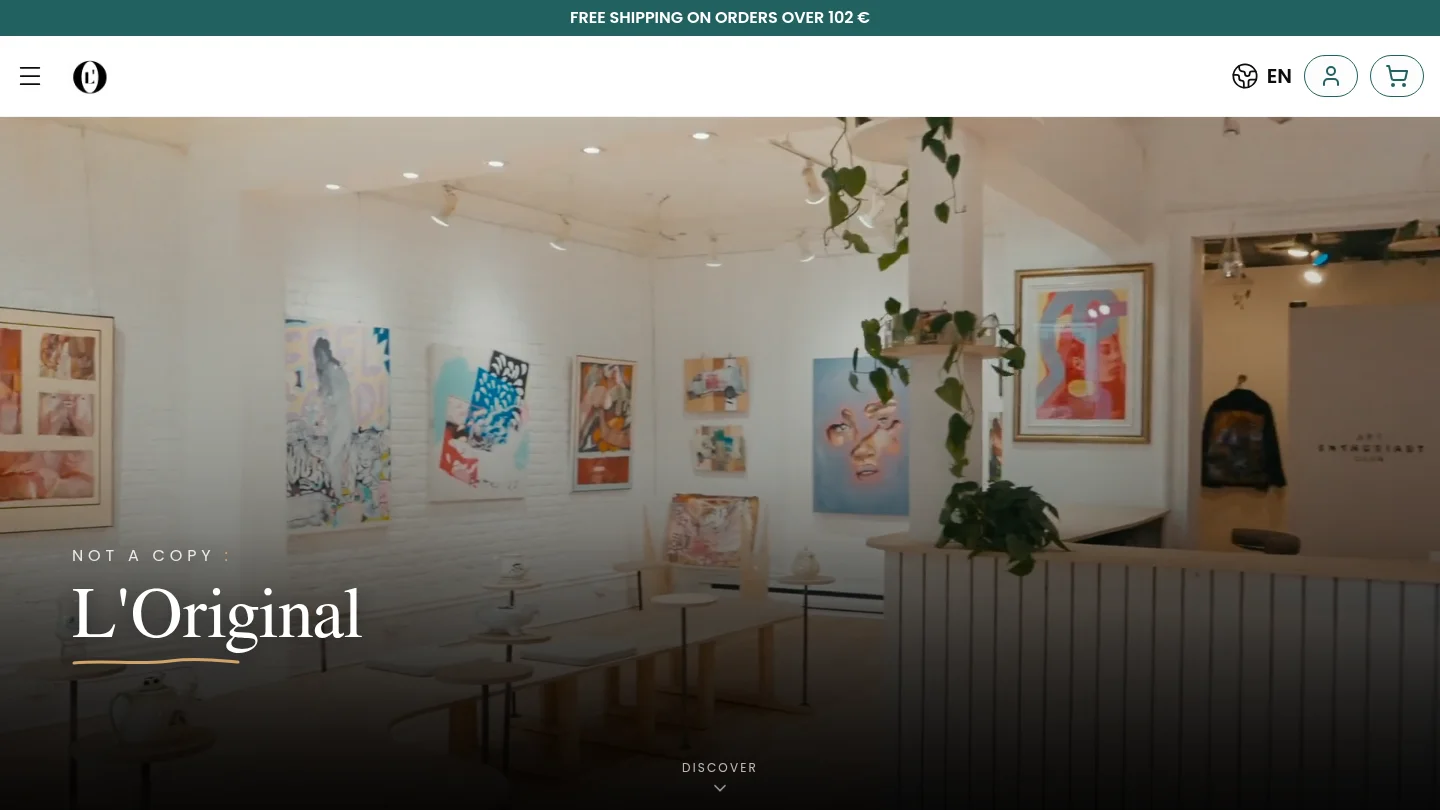
We represent 230 professional painters and sell only hand-made, signed works, with PickArt matching you to an artist in about two minutes, no sign-up required. You can buy an original outright, keep a top-3 shortlist to explore, or commission a custom piece from brief to delivery. Ready to anchor your wall? Browse our original canvas wall art and find the one that feels like you.
Frequently Asked Questions
How many pieces do I need for a gallery wall?
There's no fixed number, and in 2026 the trend leans toward fewer, stronger pieces. A tight set of two or three frames is a breeze to hang and still looks curated. Larger walls can hold more, as long as spacing stays consistent.
How high should I hang a gallery wall?
Aim to keep the center of the arrangement around 57 inches from the floor, roughly eye level. Hang it too high and it feels disconnected from your furniture; too low and it starts to feel cramped. That midpoint gives the whole display a natural sense of flow.
Are gallery walls still in style?
Yes, they're just evolving. Instead of packing every inch with small frames, the current look favors curated, intentional arrangements with more color and texture. Grid layouts and petite two- or three-piece sets are especially popular right now.
Should I use original art or prints?
Prints are affordable and easy, but originals add brushwork, depth, and a story you can't reproduce. If you want a wall that feels truly personal, hand-made pieces are worth the investment. Our PickArt flow can match you with an artist so you start from originals, not reprints.
What spacing should I leave between frames?
Two to three inches between pieces is the reliable sweet spot. More than that and the arrangement looks scattered; less and it reads as cluttered. Consistent spacing is the invisible glue that makes a handful of frames look polished.