
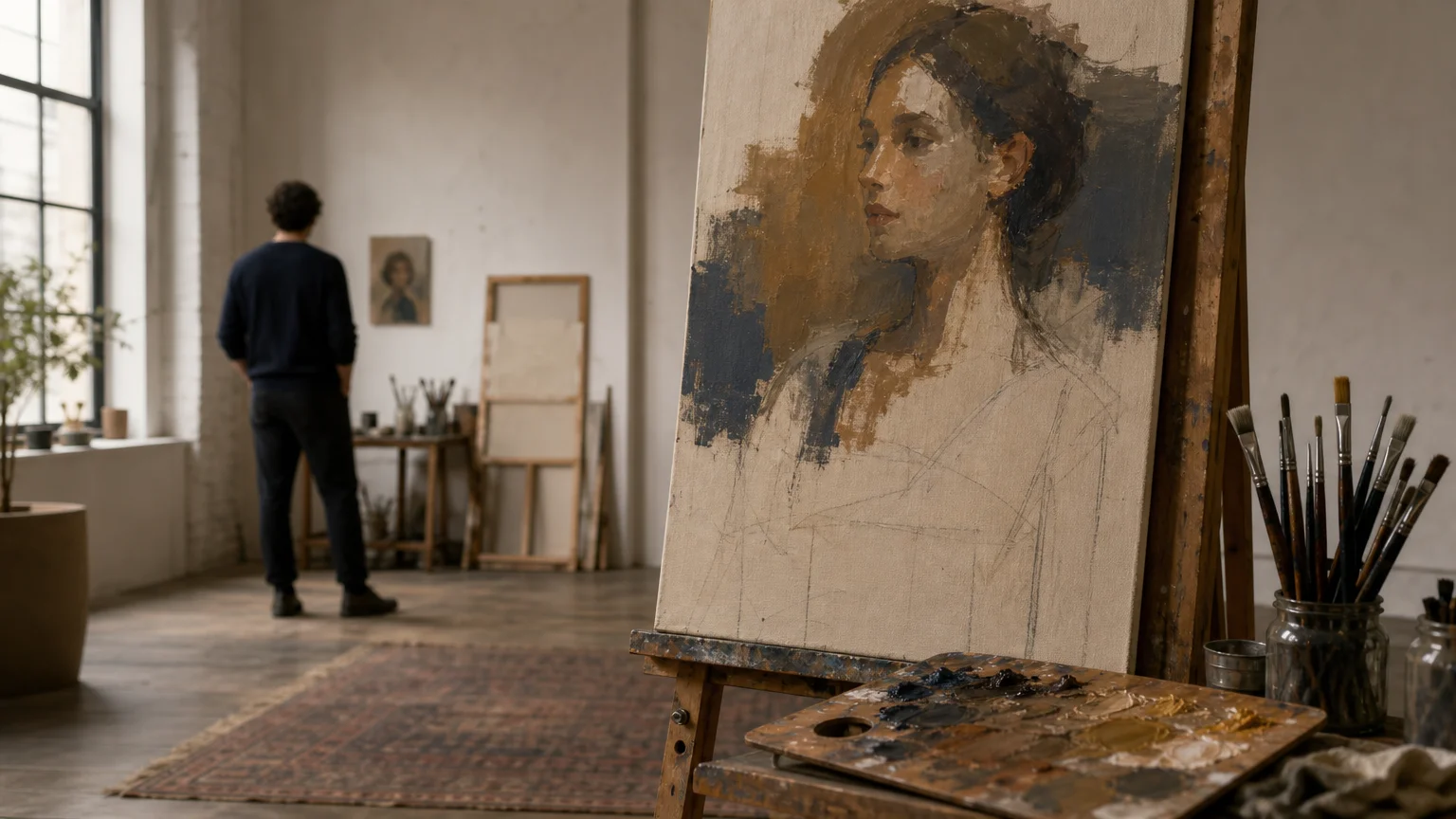

Serghei Ghetiu is a contemporary painter whose work connects recognizable subjects with strong emotional atmosphere. If you want to compare his approach with other original works, you can Explore original paintings and look beyond a single marketplace profile.
Profiles and artist interviews describe Ghetiu as a Moldovan-born painter living in Lithuania, with interests ranging from portraiture and ballerinas to nature, architecture, and still life. A 2026 artwork listing for At the coffee shop shows that new works continue to appear online, although individual listings can change as pieces are sold or removed.
Who is Serghei Ghetiu?
Serghei Ghetiu was born on January 1, 1976, in Soroca, Moldova. His early interest in drawing and modeling clay developed into formal training at the School of Arts in Soroca, where he studied from 1986 to 1991.
His biography follows a less direct route than a conventional art-school career. After secondary art education, financial difficulties prevented him from immediately continuing at the College of Fine Arts in Chisinau. He later served in the army, where his drawing skills led to work as a regimental artist.
After military service, he was offered graphic design work in Chisinau but chose not to pursue that path. He later entered the College of Fine Arts “Alexandru Plămădeală” in Chisinau, though he left after several months because of financial pressure.
Ghetiu then studied German philology and communication at university. A scholarship brought him to Germany, and he eventually moved to Lithuania with his future wife. According to artist-provided biographies, painting gradually became his main profession again after the move.
This background helps explain why his career cannot be reduced to a simple progression from art school to gallery representation. It combines formal training, interrupted studies, language education, migration, online commerce, and a gradual return to full-time painting.
How did his education shape his career?
Ghetiu’s early education provided a foundation in recognizable forms, composition, and traditional observation. He has repeatedly described realism as an important reference point, while also acknowledging the influence of impressionism and classicism.
His time away from formal painting did not end his artistic development. During his university years, he continued to paint and sold works online. That experience appears to have helped him build an international audience without relying exclusively on a local gallery network.
The artist’s move to Lithuania was especially important. Profiles describe him as working professionally there, with paintings placed in private collections and shown through galleries in Vilnius and Kaunas. These statements come from artist biographies and platform profiles, so they should be read as attributed background rather than as a complete independently audited exhibition record.
His career also demonstrates the practical value of digital discovery for artists whose biographies cross several countries. A collector in the United States, Europe, or elsewhere may encounter his work through online catalogues, marketplace listings, social media, or a commission page rather than through a traditional opening.
If you enjoy learning how artists develop outside a strictly linear career path, you can Read more art stories about artistic practice, collecting, and original work.
What defines Serghei Ghetiu’s artistic style?
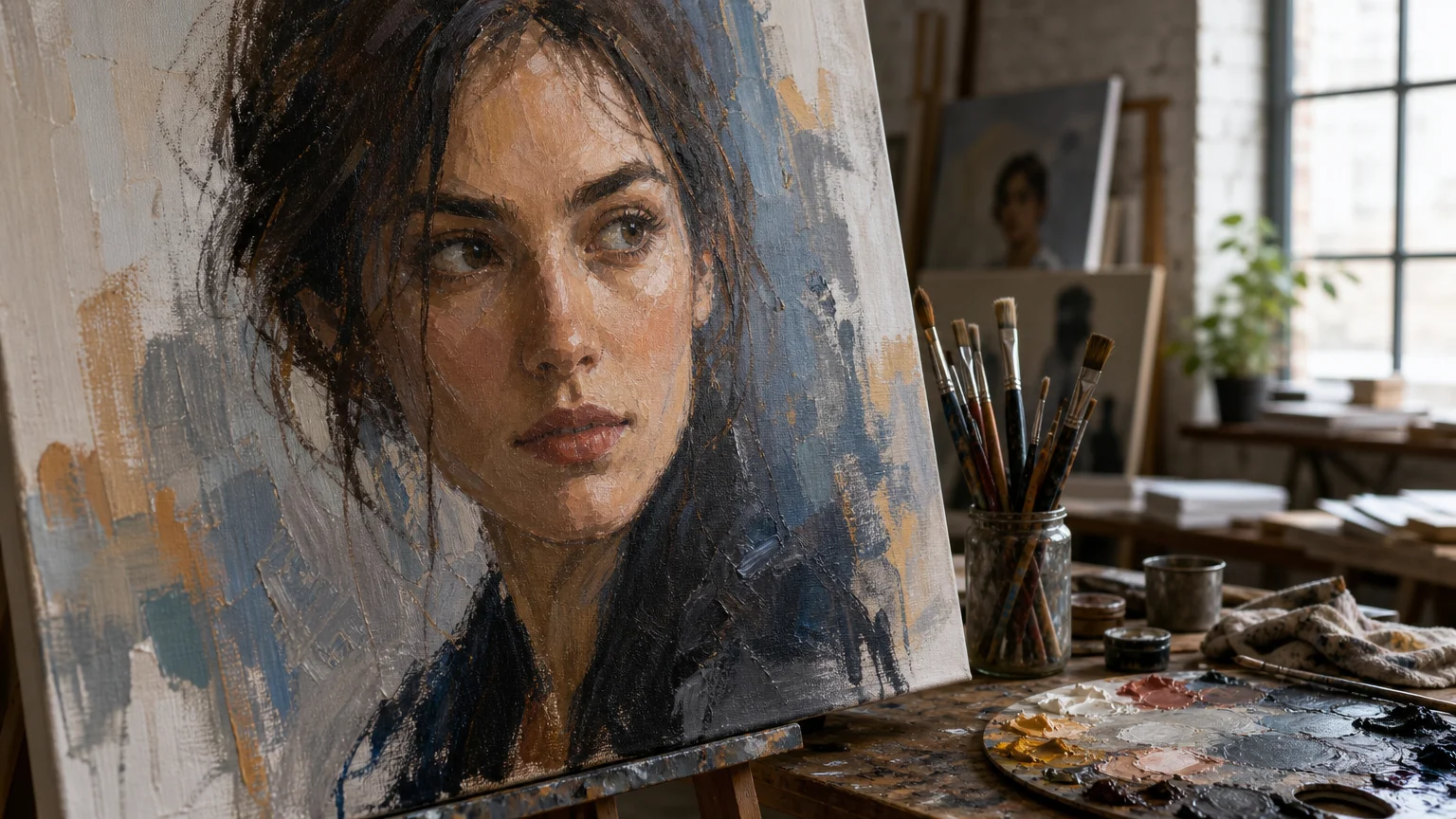
The clearest thread in Ghetiu’s work is the relationship between realistic portraiture and emotional expression. He has said that he paints to visualize feelings and moods, rather than limiting himself to one subject category.
Portraits, especially female figures, have become a recurring focus. Faces, glances, gestures, clothing folds, and poses carry much of the emotional information. The background may be less tightly described, allowing the central figure to remain visually dominant.
His work is detailed, but detail does not appear to be used only for technical display. In his own descriptions, detail is part of how he sees the world. It supports the expression of a mood, a memory, or an inner state.
Ghetiu does not present himself as a strict hyperrealist. Instead, his paintings can look realistic because of their color relationships and careful observation, even when forms or backgrounds remain more expressive. This distinction matters because it separates photographic imitation from a broader form of emotional realism.
His subject range includes women, dancers, seascapes, landscapes, architecture, still lifes, and scenes inspired by everyday life. A 2026 listing for Ballerinas illustrates the continuing importance of movement, performance, and the human figure in his available work.
Oil on canvas is his preferred medium. He has described oil as durable and flexible, allowing him to develop both detailed passages and more atmospheric areas. His process may begin with a reference and a hand-drawn composition, followed by direct brushwork and, in some cases, grisaille.
Which subjects appear most often in his paintings?
When you browse Serghei Ghetiu’s work, four subject groups appear particularly useful for understanding his practice.
- Female portraits: These works focus on expression, gaze, posture, and the emotional tension between the figure and the surrounding space.
- Ballerinas and dancers: Movement, preparation, fatigue, concentration, and theatrical lighting create a strong narrative atmosphere.
- Landscapes and seascapes: These subjects reflect an earlier and continuing interest in weather, water, distance, and changing light.
- Still lifes and scenes: Everyday settings allow him to explore color, texture, and the quiet emotional quality of ordinary moments.
His interest in the human figure does not mean every painting tells a fixed story. Instead, the viewer often receives a situation, gesture, or expression and completes the emotional meaning. That openness can make the work suitable for collectors who want figurative art without a single prescribed interpretation.
There is also a noticeable connection between classical references and contemporary online presentation. Ghetiu has expressed admiration for Caravaggio and traditional painting, while continuing to use digital channels to sell and present his own work.
What recognition and exhibitions are documented?
Available profiles list an early exhibition of young talents at the House of Culture in Soroca in 1990 and a 2002 presentation of Moldovan landscapes at the Gallery of Arts in Chisinau.
His online biographies also mention gallery visibility in Vilnius and Kaunas, private collections in several countries, and recurring international sales. Because these details come primarily from artist or platform profiles, they are best treated as documented profile information rather than as a complete institutional exhibition history.
One clearly identified recognition is a fourth-place result in the Expressionism, Human Figure category of the 2021 American Art Awards for I Will Write Your Name With Rain!, an oil painting listed at 65 by 80 centimeters.
Other online references describe exhibitions or presentations connected with cities such as Miami, Tokyo, Paris, and Taipei. The available material does not establish the exact format, dates, curatorial status, or institutional significance of every event, so those references should not automatically be interpreted as museum exhibitions.
This distinction is useful for collectors. An award, a gallery listing, an online marketplace profile, and an artist statement each provide different kinds of information. Together, they help map a career, but they should not be treated as interchangeable evidence.
How can you check current artwork availability?

Artwork availability is one of the areas where online profiles require the most care. A platform may show dozens or hundreds of works over time, but that does not mean every listed piece remains available in 2026.
For example, an earlier listing for Portrait study, a girl from the East identifies the work as a 2022 figurative portrait in oil, but the presence of a page alone does not confirm that it is still for sale. The same principle applies to works marked sold, archived, or displayed without a current purchase option.
Before buying, check the title, year, dimensions, medium, price, frame status, authenticity documentation, shipping terms, and current availability. Ask whether the work is an original physical painting, a print, or a reproduction based on an original.
You should also compare the image with the written listing. Online colors can vary by screen, while texture, surface depth, and scale can be difficult to judge from a photograph. Additional detail images may help you assess the signature, canvas edges, paint surface, and framing.
For collectors who want to discover original works beyond one artist page, our online catalogue provides another way to compare styles, dimensions, and available pieces. It can be especially useful when you know the mood or color direction you want, but not yet the exact artist.
Can you commission a painting inspired by his style?
Several marketplace profiles indicate that commissions are possible, but a commission request does not automatically mean the artist is available for every subject, size, deadline, or location. The most reliable approach is to contact the relevant platform or artist directly and describe your intended subject, format, budget, and delivery needs.
If you want a work inspired by a mood rather than a direct copy, explain the atmosphere you want to create. You might mention a quiet portrait, a dancer in rehearsal, a stormy seascape, warm evening light, or a detailed figure against a looser background.
Copyright also matters. A request to reproduce a specific existing painting, copy a famous master, or use an image commercially may require separate permission. A new commissioned work should have clear terms covering the subject, dimensions, medium, delivery, payment schedule, and permitted use of images.
Our custom artwork service follows a similar practical logic. You describe the space, surface, desired effect, mood, and format; we then match the project with an artist whose work fits and provide a quote before the work begins. This does not establish that Serghei Ghetiu is currently represented by us, so any request specifically naming him should be confirmed before commitment.
What should collectors look for before buying?
Start with the work itself, not only the artist biography. Ask whether the painting’s scale, palette, subject, and degree of detail suit the room where you plan to display it.
Next, verify the practical details. Original art should have clear information about medium, dimensions, authenticity, condition, framing, shipping, and expected delivery. Delivery times are estimates and may vary, especially when international transport or custom packaging is involved.
For a commission, the brief becomes even more important. A useful brief includes the wall or display area, preferred orientation, approximate size, colors to avoid, emotional tone, reference images, and any deadline. The more clearly you describe the intended result, the easier it becomes to assess feasibility and cost.
Finally, keep the distinction between an artist’s own statement and independent confirmation in mind. Artist interviews are valuable for understanding intention and process, while listings, invoices, certificates, and direct correspondence help confirm the specific work you are considering.
What makes Serghei Ghetiu worth exploring?
Serghei Ghetiu’s painting combines formal training, a complex international biography, oil technique, detailed observation, and an interest in emotional states. His portraits and dancers may appeal to you if you want figurative art that remains recognizable without becoming emotionally distant. His current online presence also makes discovery accessible, but each artwork’s availability, authenticity, and commission terms should be checked individually before you buy.
Find an Original Artwork for Your Space
If Ghetiu’s emotional portraits, expressive figures, or atmospheric scenes have clarified what you want, you can widen your search to artists working in related moods and techniques. Comparing original works by subject, scale, color, and atmosphere can help you choose with more confidence.
We connect you with living artists, original paintings and sculptures, custom artwork commissions, and worldwide catalogue delivery. You can Browse artists, review available works, or describe the atmosphere you want for a custom project. Made-to-order artworks are generally non-refundable and non-exchangeable except in exceptional circumstances, and delivery times are estimates that may vary.
Frequently Asked Questions
Where was Serghei Ghetiu born?
Serghei Ghetiu was born in Soroca, Moldova, on January 1, 1976. He later moved through Germany and settled in Lithuania, where profiles describe him as working as a full-time painter.
What type of art does Serghei Ghetiu create?
He creates oil paintings that include portraits, female figures, ballerinas, landscapes, seascapes, still lifes, and scenes from everyday life. His work is generally associated with realism, impressionistic atmosphere, and strong emotional expression.
Is Serghei Ghetiu a hyperrealist?
He has said that he does not consider himself a hyperrealist. His paintings can appear realistic because of their colors, details, and recognizable subjects, while the forms and backgrounds may remain more expressive.
Can you commission a painting from Serghei Ghetiu?
Several artist and marketplace profiles indicate that commission requests are possible. Availability, subject, price, timing, and delivery should be confirmed directly before you make a commitment.
Does L’Original currently represent Serghei Ghetiu?
The available information does not establish that Serghei Ghetiu is currently represented by L’Original. Our catalogue and custom artwork service can still help you discover other living artists or develop a project with an artist whose style fits your space.