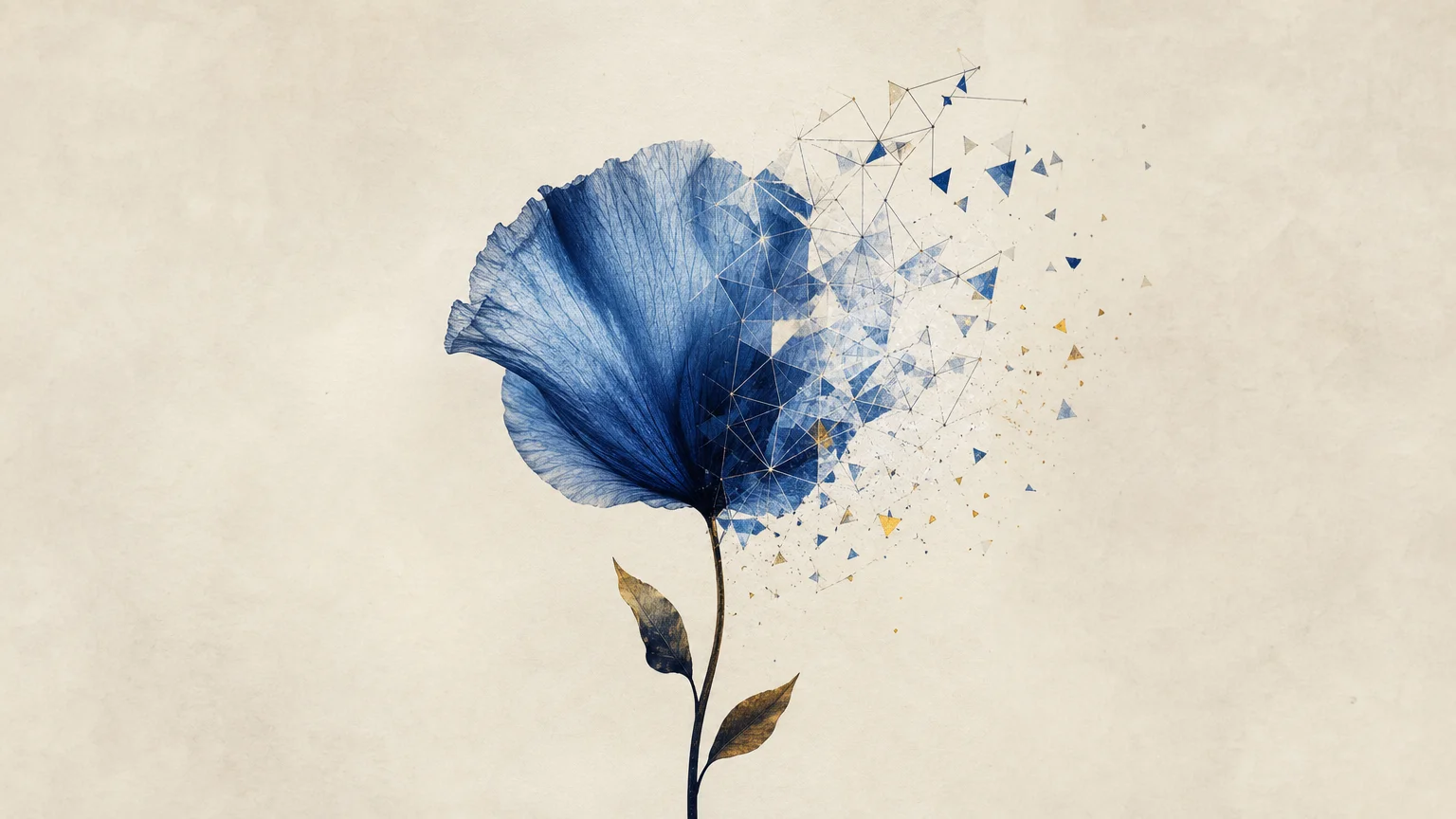

What happens when a photograph becomes more than a record of reality? In Marie-Fa Lazzari’s work, the camera often marks the beginning of a longer visual exploration. Nature, light, trees, flowers, shadows, and fragments of the everyday world become raw material for images that feel poetic and open to interpretation. If you want to compare her approach with other living creators, you can browse artists on the gallery.
Her 2026 artistic news includes the Premier Prix du Jury from the Académie Européenne des Arts-France, awarded on April 23, 2026, for works from her “Décalages” series. Her schedule also includes exhibitions and artist events across Paris and the surrounding region, with a further DF Art Project exhibition scheduled for October 2 to 11, 2026, according to her 2026 exhibition page.
What defines Marie-Fa Lazzari’s photographic language?
Marie-Fa Lazzari’s images sit between observation and transformation. She begins with something seen in the world, but she rarely leaves it untouched. A tree can become a calligraphic structure. A flower can turn into a field of color. A shadow can suggest a figure, a memory, or an unknown place.
This approach gives her photography a flexible visual identity. Some works move toward abstraction, while others retain recognizable references to landscapes, plants, animals, theater, or the human figure. The connection between these subjects is not a fixed style. It is a way of looking, based on attention, fragmentation, light, and the possibility of wonder.
Her work also brings together black-and-white photography and color. Black and white can emphasize shape, contrast, silence, and atmosphere. Color introduces emotional intensity, especially through recurring blues, reds, oranges, and luminous tones. The result is photography that often feels closer to visual poetry than straightforward documentation.
How does her process move from reality to image?
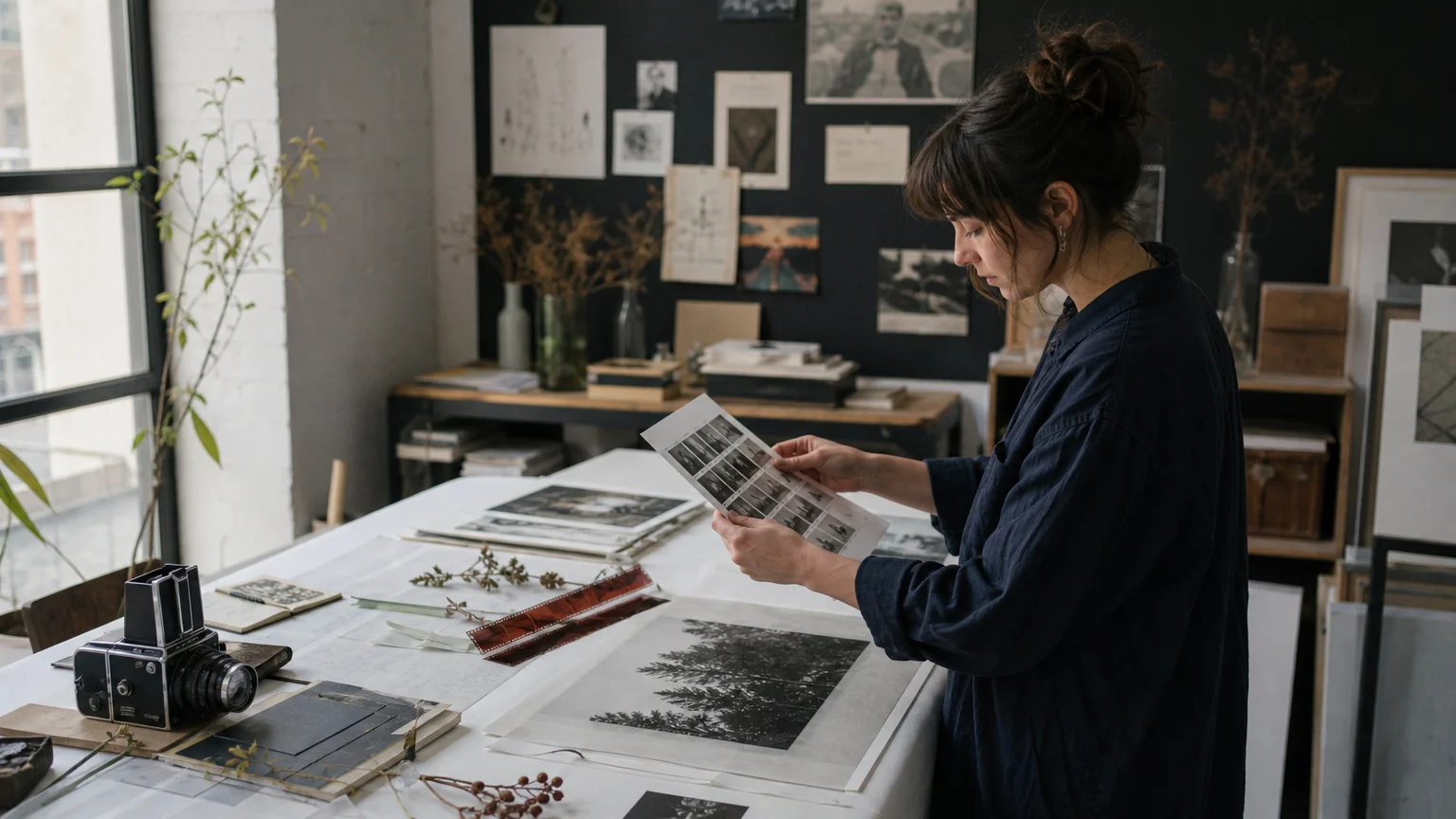
The creative process is central to understanding these photographs. Lazzari has described photography as a path toward an artwork rather than a final destination. The initial image provides a foundation, then composition, cropping, color, texture, and layering can shift its meaning.
Her techniques include analog and digital photography, photograms, rayograms, scanography, collage, photomontage, digital painting, and work on silk. These methods change how the viewer understands the image. A photogram, for example, uses objects placed directly on light-sensitive paper. It can preserve the physical presence of an object while moving it into an unfamiliar visual reality.
That tension between material and imagination is one of the most distinctive features of her practice. You may recognize a leaf, a bird, water, or a flower, yet the final composition can feel detached from ordinary scale. Fragmentation makes the familiar unstable. It invites you to look longer and build your own interpretation.
The choice of support also matters. Textured cotton paper, photographic paper, and silk can produce different sensations of depth, softness, and tactility. In this context, a limited edition is not simply a smaller version of a digital file. It becomes a physical object shaped by the image, the paper, the printing method, and the artist’s decisions.
Which themes appear throughout her work?
Nature is one of the most consistent sources of inspiration in Lazzari’s photography. Trees, flowers, water, birds, minerals, and changing light appear as subjects, symbols, and formal structures. Her images can celebrate the beauty of the natural world while also suggesting fragility, alteration, or ecological vulnerability.
Several recurring themes help connect different series:
- Nature and living forms, including trees, flowers, birds, water, and landscapes.
- Fragmentation and abstraction, where reality is divided, enlarged, or recomposed.
- Shadow and silhouette, often used to create mystery and visual ambiguity.
- Color and light, especially blue, red, orange, and luminous contrasts.
- Poetry and writing, through texts, poems, artist books, and visual associations.
- Transformation, where an observed subject becomes an imagined or symbolic space.
Her background in literature also informs the relationship between words and images, without making the photographs dependent on written explanation. The image can stand alone, while a poem or title opens another interpretive path.
How should you look at one of her photographs?
Start with the first impression. Ask what you notice before trying to identify the subject. Is it the color, the texture, the empty space, the silhouette, or the contrast between recognizable and abstract forms?
Next, consider the image’s physical presence. A small limited edition may encourage close viewing and private reflection. A larger work can change the atmosphere of a room through color, rhythm, and scale. The right choice depends on the relationship you want between the photograph and its surroundings.
It’s also useful to ask whether you’re drawn to a clear subject or to a more open composition. Works centered on trees, flowers, or birds may create a direct connection with nature. Fragmented or abstract works may offer more visual ambiguity and can reveal different details over time.
For collectors, practical details matter as much as emotional response. Check the edition size, dimensions, print support, signature, numbering, certificate, framing, and shipping conditions. When you’re buying online, request additional images or ask how the work appears in natural light before making a decision.
We approach this discovery process through artist curation and visual variety. If you’re comparing presentation options, our guide to choosing an online art gallery for artists can help you assess how an artist’s work is presented, documented, and made available to collectors.
Where can you see Marie-Fa Lazzari’s work in 2026?
In 2026, her exhibition activity includes group shows, salons, open studio events, and gallery presentations in Paris and nearby cities. Her documented schedule includes the Salon International des Arts at Galerie Nesle in April, the Salon d’Été at Galerie Thuillier from June 19 to July 2, and several events connected with Zig Zag and other artistic organizations.
Her “Décalages” series received the Premier Prix du Jury at the 43rd Salon International des Arts on April 23, 2026. The series is important because it shows how her current work continues to investigate distance, displacement, visual interruption, and altered perception.
A forthcoming DF Art Project presentation is scheduled at La Serre de l’Orangerie in Paris from October 2 to 11, 2026. The announced theme, “Altération / Transmutation / Jeu de Résonances,” is consistent with the broader direction of her work, where familiar forms move toward new visual and emotional states.
These events also show how an artist’s practice develops through series rather than isolated images. Looking at multiple works together can reveal repeated colors, shapes, subjects, and gestures that aren’t always visible in a single photograph.
What does her work reveal about contemporary photography?
Marie-Fa Lazzari’s practice reflects a broad understanding of photography. The medium can document, but it can also fragment, layer, distort, print, scan, stage, and recompose. This makes photography a bridge between observation and invention.
That broader view is relevant in 2026, when institutional arts research continues to distinguish between artists and cultural workers, participation, cultural assets, and arts education. The United States National Endowment for the Arts tracks these areas through its National Arts Statistics Center. For photographers, visibility therefore involves more than producing images. It also includes exhibitions, documentation, editions, public presentation, and access to audiences.
International support for photography also remains visible in current cultural programs. In 2026, the Institut français reported support for 38 visual arts and photography projects through its Programme International de Diffusion Artistique, including nine photography projects, as shown in its 2026 PIDA results.
Lazzari’s work fits this expanded view of the medium. It combines the camera with laboratory practice, digital tools, physical supports, text, and exhibition contexts. The photograph becomes both an image and an object, with meaning shaped by how it is made, printed, displayed, and experienced.
How can you collect or explore her work online?
If you’re discovering Marie-Fa Lazzari for the first time, begin with a series rather than a single title. Look for relationships between works, then compare their color, scale, technique, and subject. This approach helps you understand whether you respond most strongly to her botanical imagery, dreamlike compositions, photograms, silhouettes, or abstract fragments.
Online viewing is useful for research, but it has limits. Screen color can vary, and a digital image can’t fully communicate paper texture, print depth, or physical scale. Before buying, ask for the edition details, the exact dimensions, the support, the framing status, and the authenticity documentation.
Artists also need to think carefully about how their work is presented online. A coherent catalogue, clear images, accurate descriptions, and accessible contact options help viewers move from casual interest to serious consideration. For artists building that presence, we’ve prepared our websites for artists to show their work guide.
For buyers, the most useful platform is one that combines discovery with context. You should be able to understand the artist’s approach, compare works naturally, and ask questions before committing. That combination is especially valuable for photography, where the difference between a reproduction, a limited edition, and an original physical work needs to be clear.
Seeing photography as a path to wonder
Marie-Fa Lazzari’s photography invites you to slow down and look beyond the first recognizable subject. Her images transform nature, light, shadows, and fragments of reality into poetic spaces shaped by technique and imagination. When you explore her work, pay attention to the dialogue between image and material, observation and abstraction, stillness and movement. That dialogue is where the work becomes more than a photograph, it becomes an invitation to see differently.
Take action with L'Original
If Lazzari’s approach has made you curious about original photography, you don’t have to rely on a single search result or a limited view of one artist’s catalogue. Exploring living artists side by side can help you compare materials, moods, techniques, and visual intentions with greater confidence.
At L’Original, we curate original works by living artists and help buyers discover pieces that fit their taste, space, and personal intention. You can browse artist catalogues online, request guidance, or explore options for an original work that feels meaningful to you. Start with the Marie-Fa Lazzari artist profile and continue exploring related photographic approaches.
Frequently Asked Questions
What kind of photography does Marie-Fa Lazzari create?
She creates poetic photography that can combine analog and digital methods, black and white, color, photograms, scanography, collage, photomontage, and other mixed techniques. Her images often move between recognizable natural subjects and abstraction.
What subjects appear in her photographs?
Her work frequently explores trees, flowers, birds, water, landscapes, shadows, silhouettes, and fragments of the natural world. These subjects may be presented realistically or transformed into dreamlike and symbolic compositions.
Are Marie-Fa Lazzari’s works available as limited editions?
Yes, her work is presented in limited editions, with formats and supports varying by series. Before purchasing, confirm the edition number, dimensions, printing support, signature, certificate, and framing details.
Where can I see her work in 2026?
Her 2026 schedule includes exhibitions and salons in Paris and nearby cities, including events at Galerie Nesle, Galerie Thuillier, Zig Zag, and other artistic venues. Her own exhibition updates provide the most direct way to check dates and locations.
Can L’Original help me discover photography by living artists?
Yes, L’Original’s artist catalogue and visual discovery approach can help you compare original works by living artists. You can explore different styles, contact the team, and ask for guidance when you’re unsure which artwork suits your space or taste.